
If you’ve been doing all the viral trends on TikTok, creating instagram posts about the latest pop culture or news events and using marketing templates you found online, you may have noticed something: Your vanity metrics (views, likes) rise, but conversions (actual sales/inquiries) haven’t budged.
We’ve got some bad news. You’ve been looking in the wrong place for your digital marketing strategy.
Many business owners and marketing managers feel they need to follow the herd in terms of current digital marketing trends. The pressure to please the algorithms is real. But successful brands know it’s important to listen to their audience – not trends. It’s called “Social Listening” and it’s one of the most effective ways to build a marketing strategy based on real audience behavior instead of trends.
Why Following Social Media Trends Doesn’t Lead to Conversions
It’s easy to believe the illusion that if you’re not pleasing the algorithm you’re going to get ignored. The good news is, the days of being socially ostracized because you only have 100 views on a Reel or 13 likes on a post are behind us. The baseline for social proof has evolved from vanity likes. (Hooray!)
Instead, your audience is looking to see real, authentic engagement from your followers. This means you have permission to stop filming yourself doing silly dances (unless that’s the vibe of your brand, of course!).
And it’s not just the trending dances, it’s all the made-up “mandatory” rules you’ve seen online.
- “Don’t post longer than 3-second videos”
- “Post 3 times per day”
- “Use trending audios”
- “Only use block text”
We’ve heard them all. And while they may work some of the time, there’s no data to support their value. Plus, there is plenty of conflicting advice out there. The bottom line? Pushing yourself to the front of the explore feed captures the attention of the people who love to scroll, while your real leads get cold waiting to hear why they should buy from you.
Sure, you may get thousands of views and likes, but they’re mostly from people who have absolutely no interest in ever using your business. And then the algorithm will show your content to more of the same type of people who will never buy from you, leading your page down a rabbit hole that’s hard to climb out of.
If you need more ideas on how to spark engagement on social media, check out our guide to increasing social media engagement.
What Is Social Listening in Marketing?
Social listening is the process of monitoring and analyzing conversations, comments, and behaviors across social media platforms to understand your audience’s needs, preferences, and pain points. In marketing, social listening helps brands create content that resonates, builds trust, and drives conversions.
Social listening is simply paying attention to your audience by observing what they’re saying and doing online. It involves monitoring comments, DMs, reviews, shares, saves, and conversations on your own content, but also on your competitors’. Act like an anthropologist, in a way, by learning more about what makes your audience tick.
Here’s an idea of what social listening can teach you!
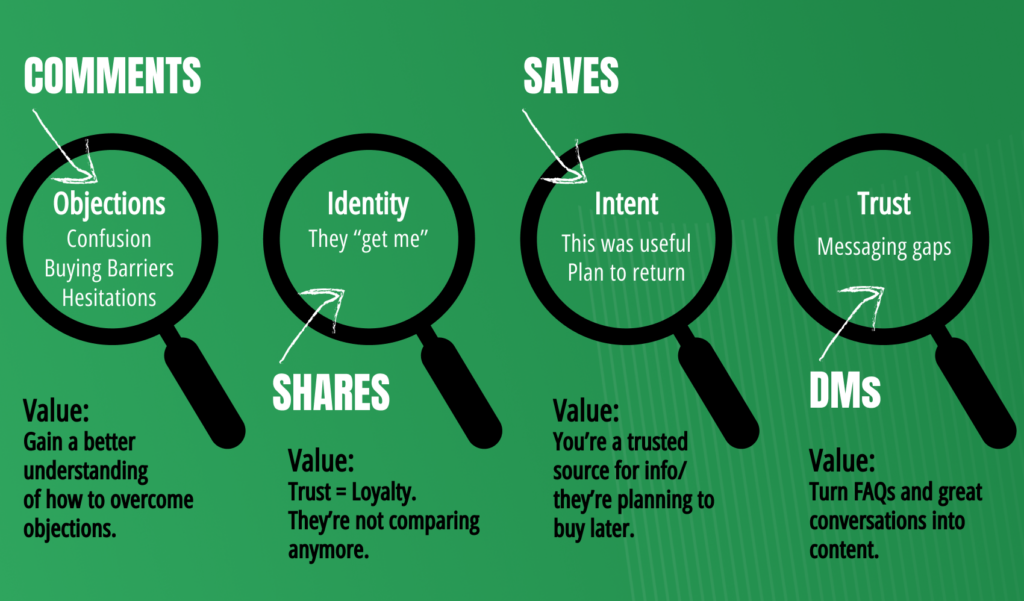
How to Practice Social Listening (Step-by-Step)
- First, start by reviewing your last 30 days of content. There’s no need to make this an enormous job by analyzing a whole year’s worth of data. Even 30 days can reveal a lot!
- Next, identify top-performing posts by conversions, comments, saves, or DMs. These will be the posts you look at closely.
- From there, categorize common themes or language used by your audience. Is there a common denominator between all these posts? Are there buzzwords, similar stylistic choices, maybe even similar music, etc.? What has people pausing to engage more here?
- Finally, dissect these posts to understand your audience’s actual behavior, desires and pain points.
What to “Listen” For
Here’s what you should be looking for as you dissect, and how to use it to reform your content strategy:
Search your competitors’ comment section
- Listen to why their customers love them to discover more about who your audience is and what they value.
- Find out what their customers don’t love about them, or what they’re missing, and then do it better.
Spoiler: You can even do this on your competitors ads! People are very honest about what ads appear in the feed and tend to leave real-time feedback. Read it!
Look for patterns
Look for patterns like frequently asked questions on both your and your competitors’ pages. Then, answer them in your content. By giving your audience exactly what they’re looking for, you:
- Give them plenty of reasons to come back to your page for more info
- More invitations to engage with you online
Identify emotional triggers for your audience
Does your brand provide a solution to a real fear or problem your audience faces? (Hint: It should!)
- Find what triggers those emotions of fear, identity, belonging, safety, etc.
- Create content that shows how your product solves the problem
Watch which posts spark real conversations
Search your past posts to see which were successful in creating a conversation. In other words, which posts have the most engagement in the comments or sparked DMs. Then, continue the conversation by:
- Creating more content around these subjects
- Responding genuinely to comments in your future posts
This type of content actually serves your audience, making them more likely to stick around – and buy that product/ book that service over and over again. Plus, it brings your audience to you instead of you chasing them (bye, algorithm).
Don’t worry if you don’t have a ton of engagement yet. You don’t need to have hundreds of recent comments for this to work. Start by using what you have, and go from there. No comments? Go with the posts that have the most likes. It’s OK to start small and build!
Why Social Listening Works
More than ever, your audience is looking for authenticity – real brands that actually solve their problems. Brands that use social listening effectively don’t just create content, they create messaging that reflects exactly what their audience is already thinking. When it comes to choosing a business, we have more choices than we’ve ever had, and the internet makes them all readily available. Showing your audience who you are and why they should choose you (and doing it quickly!) has never been more important. You don’t have time to play algorithm games.
Remember:
- People respond well to brands they feel “just get it.” They feel seen and heard.
- Feeling seen and heard builds trust. You’re more than a brand, you’re their partner in solving whatever problem it is.
- Trust builds conversions.
Especially today, in a time when it’s hard to trust anything or anyone, trust is what you should be trying to develop. And don’t forget to keep it. Once you’ve earned your customers, remember to deliver on your promise. For example, if you promise to provide gentle, individualized care for dental patients, make sure that’s exactly the experience they have. Otherwise, rest assured you’ll see it in the comments – and so will your competitors while they’re doing their own social listening.
Stop Chasing Trends—Start Listening to Your Audience
Before you post that next viral trend, ask yourself, will my customers actually care about this? Does this help them make a decision to buy by, for example, educating or relating to them, or by helping them trust me more? (Hint: This is the type of content that helps move your audience through the marketing funnel.) Vanity metrics no longer set the bar for social proof online. The key is to keep it real, by having real conversations and sparking actual engagement. And it starts with social listening.
Let’s stop guessing.
If you’re ready for a strategy built around real audience insights that actually attracts customers, we’re here to help. Reach out to find a time to chat.